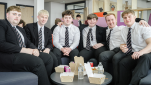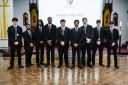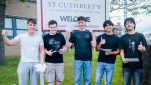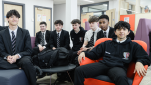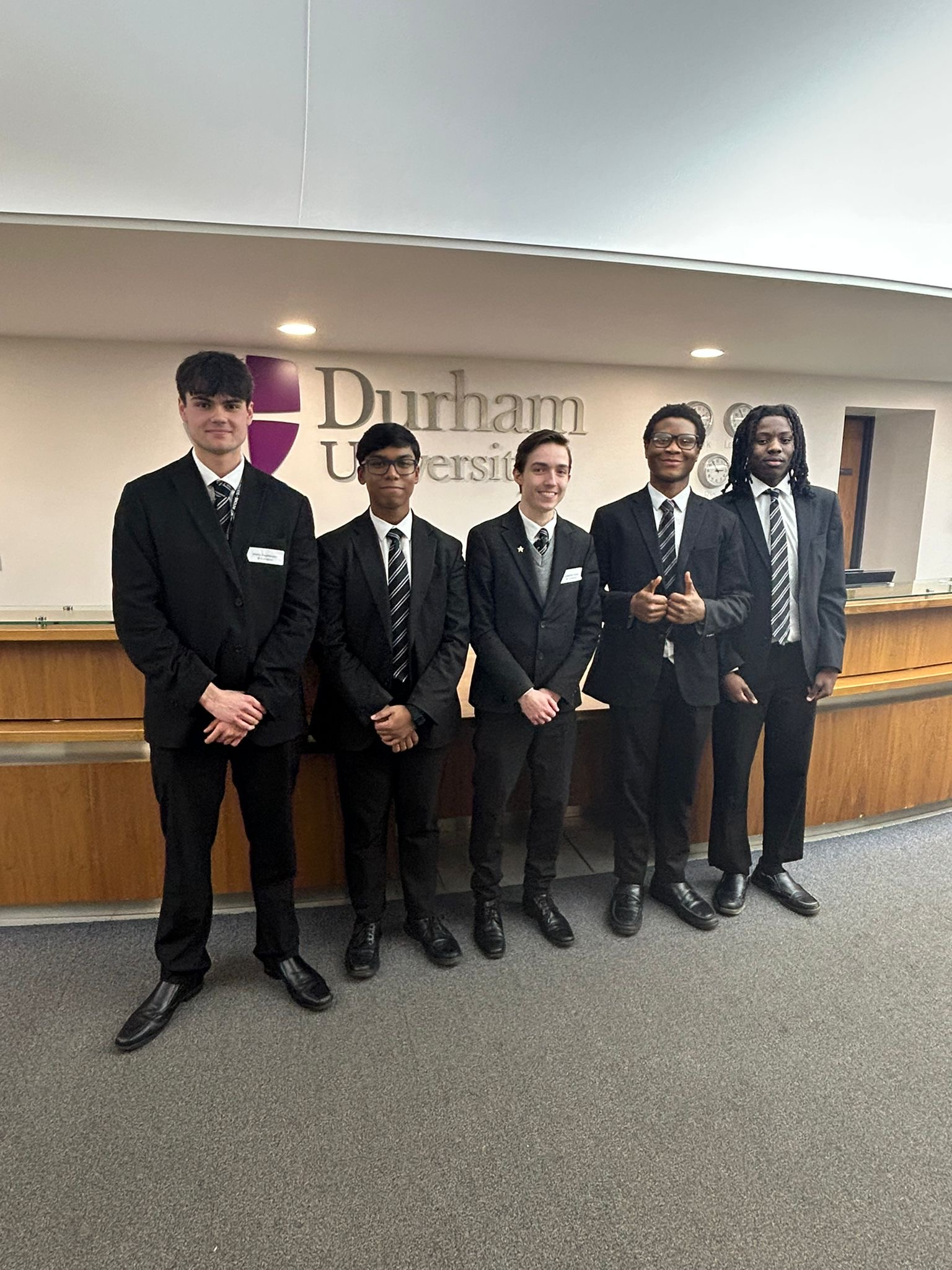



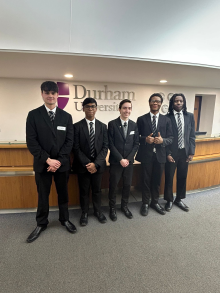
Topics as diverse and controversial as trans-women in sport, race-based preferences in dating, and the use of deep-fake nudes were under consideration when students from St Cuthbert’s took part in this year’s Ethics Cup.
Our team won all their debates in the qualifying stages of the tournament to secure a place in the final, which is due to take place at the University of St Andrews in May.
“Students from St Cuthbert’s Catholic High School competed in the Ethics Cup at Durham University, demonstrating exceptional critical thinking, teamwork, and ethical reasoning in a highly competitive environment,” said our Deputy Head, Mr Swindells.
“The Ethics Cup is a national competition designed to challenge students to debate complex, real-world issues, encouraging them to think carefully, listen respectfully to opposing views, and construct well-reasoned arguments. Teams accumulate points across rounds, with the highest-scoring teams progressing to later stages, and ultimately qualifying for the final.”
After their first two debates, St Cuthbert’s five-strong team had accumulated the highest number of points, meaning they were the first to progress to the semi-final. There, they beat St Leonard’s to reach the regional final, where they triumphed over Durham High School to again emerge victorious.
Other schools competing for a chance to claim the coveted Cup included St Bede’s, Teesdale, Framwellgate, and Keswick.
Launched by the Department of Philosophy at St Andrews in 2018, the annual competition is open to secondary schools across the UK, and challenges teams of three to five students to discuss ethical issues drawn from a pre-released list of set cases, with judges awarding points for ‘insightfulness, thoughtfulness, and civility’.
“Although only five students could compete on the day, the success of the team was built on the efforts of a much larger group,” continued Mr Swindells. “A dedicated ‘training team’ supported preparation, made up of three judges, a timekeeper, and an opposing team. Other pupils acted as researchers and observers, providing detailed feedback to help refine arguments and delivery.
“Preparation included seminars, extensive reading, discussion of each case set, and exploration of additional literature and statistics. In the final two weeks before the competition, the final team was selected, with each student becoming an expert in three topics, ready to lead if their case set was chosen.”
“The team’s success is a testament to the collaborative effort behind the scenes, as well as the skill and dedication shown on the day.
“The team now looks forward with excitement to representing the school in the final at St Andrews.”